Introduction
Anyone who has tried to photograph a baby knows that the difficult part is not pressing the camera button. The baby can turn the head, close the eyes, move the hands, or start crying just when the lighting looks right.
A baby passport photo does not need to look like a studio portrait. It needs to show the child clearly against a plain background while following the rules for the exact application. Small age based exceptions sometimes apply, but they do not remove the need for a clear face and a truthful photograph.
A calm setup at home can give you several usable photos. It also gives you time to check the original image before you crop or prepare the final file.
Start with the exact baby passport photo rules
Do not use one country’s baby photo rule for another application. The age exception, background wording, photo size, and digital file requirements can change between authorities.
| Authority | Relevant rule for babies or young children | What it means at home |
|---|---|---|
| United States passport | An infant’s eyes do not have to be entirely open, but no other person or support should appear in the photo | Use a plain sheet and wait for a clear frame where the baby’s face is visible |
| United Kingdom passport | Children under one do not have to keep their eyes open. Children under six do not have to look directly at the camera or keep a plain expression | A relaxed expression can be acceptable, but the child still needs to be alone in the photo |
| Canadian passport | A newborn can be photographed in a car seat when a white blanket is placed behind the head and there are no shadows | Keep the blanket behind the head only and make sure it never covers the baby’s face |
| Indian passport application | Passport Seva has separate instructions for minors below four. The published guidance refers to a white background, a 45 mm by 35 mm photo, and a face covering about 80 to 85 percent of the image | Check the current Passport Seva instructions before preparing a printed baby passport photo |
The United Kingdom and United States examples allow some flexibility for infants. That does not mean every application accepts closed eyes or a moving face. If the official page gives a specific exception, follow that exception. If it does not, take another photo.
How age changes the photo requirements
Age based flexibility is mostly limited to the child’s eyes, expression, or ability to look directly at the camera. It does not automatically allow a parent, toy, dummy, pacifier, hand, or support pillow to remain visible.
For a newborn, the face can be relaxed and the eyes can close between frames. For an older baby, the child can need to face the camera more directly. The exact change depends on the authority rather than on a universal baby passport photo rule.
Use the child’s age as a reason to read the instructions carefully. Do not use it as a reason to ignore a visible problem in the image.
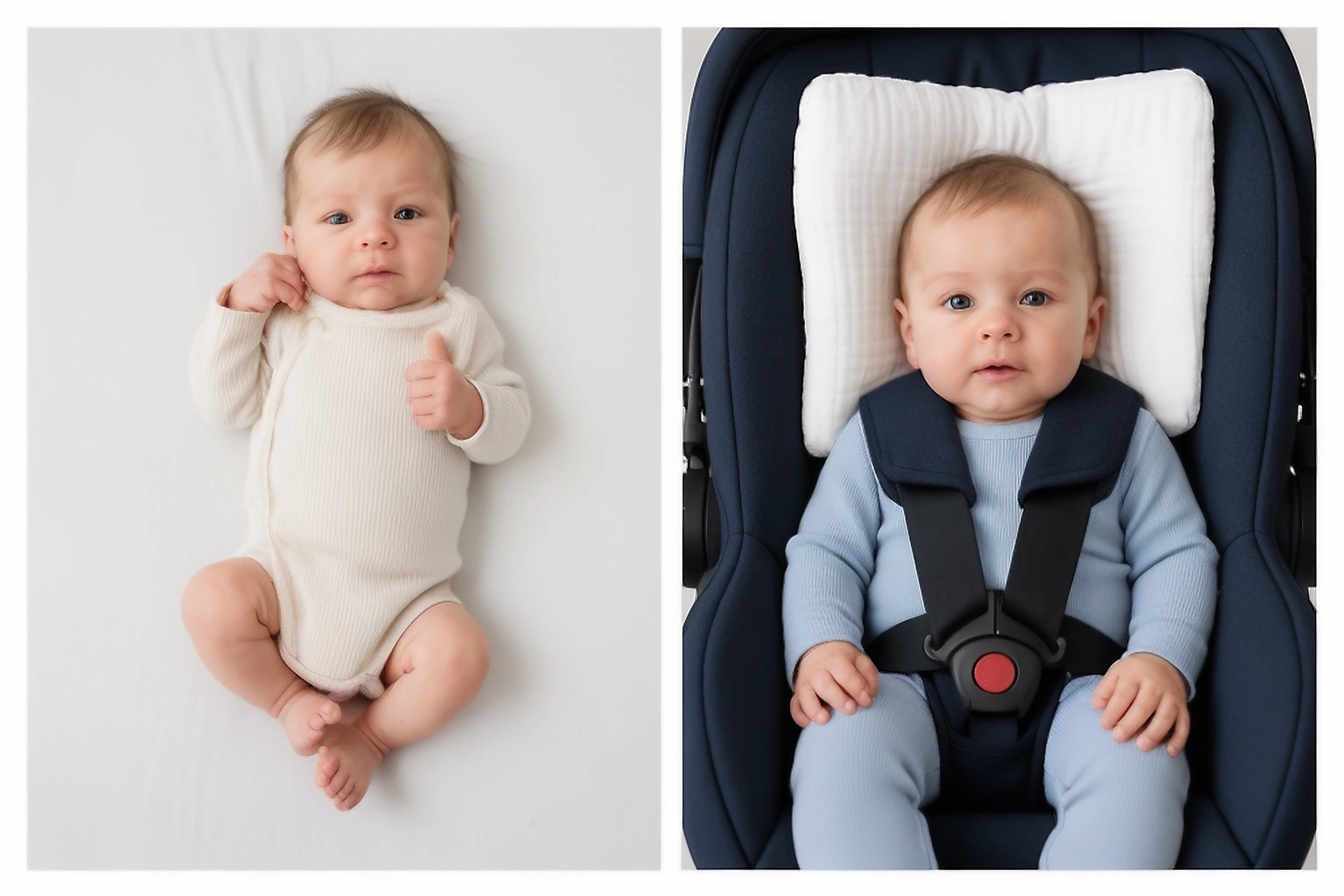
A safe home setup for a newborn photo
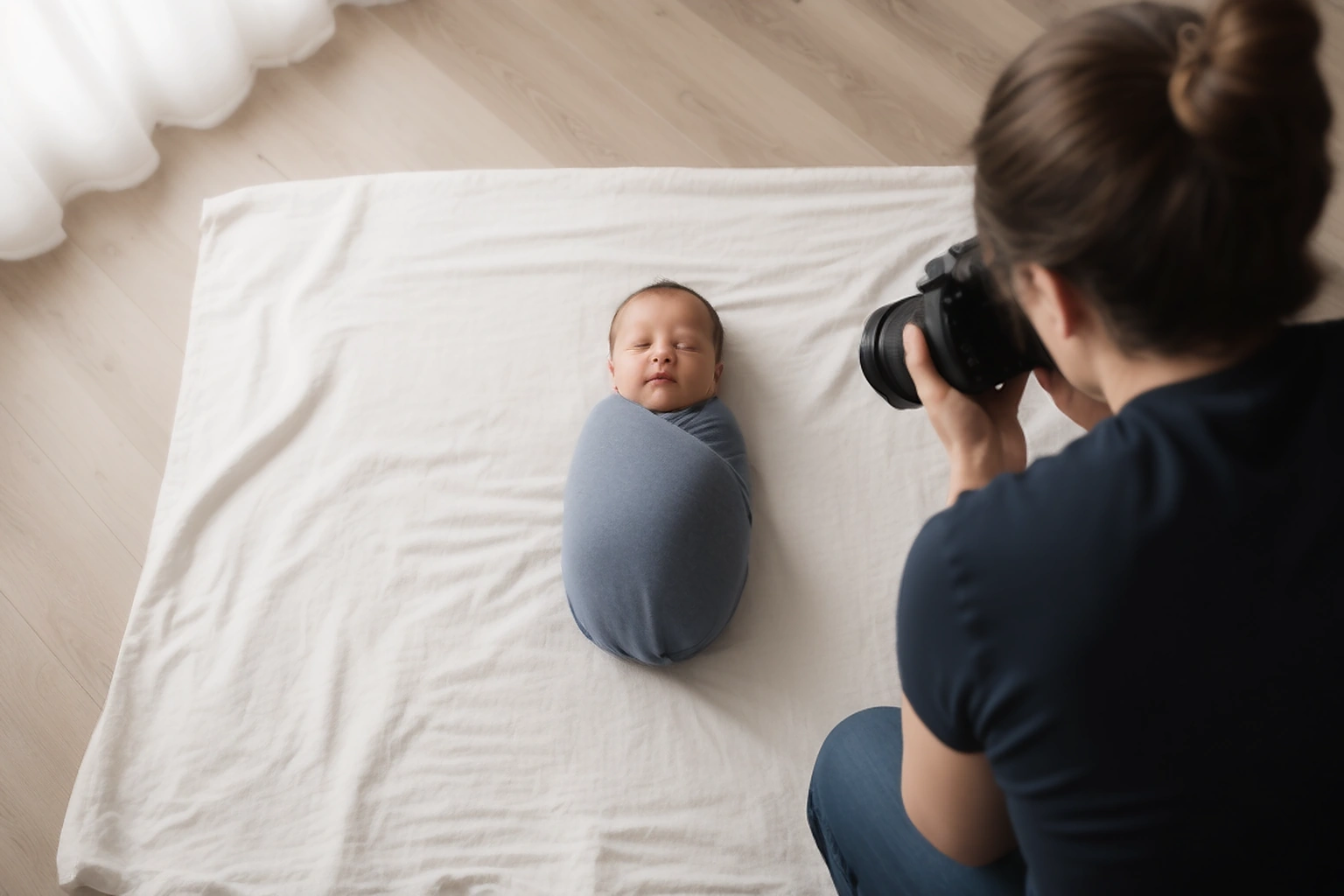
The simplest setup is a plain light coloured sheet spread over a stable low surface. A floor level setup gives you more room to work and reduces the risk of a fall if the baby suddenly rolls or moves.
Keep one adult beside the baby throughout the session. The adult can calm the child and keep the setup safe, but no hand, arm, toy, cushion, or other support should appear in the final frame.
Natural light from a nearby window can give a softer result than a direct flash. Turn the baby away from strong sunlight because bright light can create harsh shadows and make the face look uneven.
Use this four point setup:
- Choose a plain white or light coloured sheet without folds that create strong lines behind the head.
- Place the sheet on a stable low surface so the baby cannot fall from a bed, table, or chair.
- Keep the light in front of the baby or slightly to one side so the face is visible without a hard shadow.
- Keep the camera above the baby and far enough away to avoid making the face look unusually large.
If the baby is photographed in a car seat, follow the exact authority rule. A blanket can be placed behind the head for some applications, but it must not cover the nose, mouth, or face.
What can and cannot appear in the frame
The baby should be the only visible person. This includes the final cropped image, not just the original photo.
| Item in the frame | Safer approach |
|---|---|
| Parent’s hand or arm | Use it outside the crop while keeping the baby supported safely |
| Toy or soft object | Remove it because it can distract from the child and can violate the application rules |
| Dummy or pacifier | Remove it before taking the final photo when the instructions prohibit it |
| Pillow or visible support | Use a safer hidden support only when allowed, then check that no part appears around the head |
A hand used to support a newborn can be acceptable during the setup, but it must not appear in the submitted image when the authority requires the child to be alone. Do not erase the hand later with an editing tool. Take another frame with the helper’s hand outside the camera view.
The same point applies to toys and pacifiers. They can keep a child calm for a short time, but they can turn an otherwise clear image into an unusable one.
How to take the photo when the baby keeps moving
There is no need to make the session long. Wait for a calm moment and keep the camera ready before moving the sheet or changing the light.
Take several photographs while the baby is relaxed. Review them only after the short session because stopping after every frame can make the child restless again.
Look for a frame where the face is not turned sharply to one side. In many applications, the full head should remain inside the image and both sides of the face should be visible. A partly closed eye can be acceptable for a young infant under one authority but not under another.
Check these points on the clearest frame:
- The baby’s face is fully visible.
- No adult, hand, toy, dummy, or support is visible.
- The light is even across the face.
- The image is sharp and free from motion blur.
If every frame is blurred or the head is turned away, wait and take another set. Cropping cannot repair a photograph that did not capture the child clearly.
A practical example from the first photo to the final file
Imagine a seven week old baby lying on a plain white sheet. The baby is alone in the frame and the face is sharp, but the eyes are only partly open.
For a United Kingdom application, the under one rule can allow that frame. The United States also gives infants some flexibility when the eyes are not entirely open. Even then, the baby’s face should remain clear and the image should show a true likeness.
Now consider the same image for an Indian passport application. Passport Seva guidance for minors gives more specific instructions about the photo size, white background, face position, and visible eyes. The current Indian instructions should be checked before using the image.
This example shows why the correct workflow starts with the application page. The same photograph can be suitable for one route and unsuitable for another.
When a new photo is safer than editing
Editing can help with permitted technical preparation such as choosing the required dimensions. It should not be used to create facial detail, erase a parent’s hand, open closed eyes, or change the baby’s natural appearance.
| Problem in the original photo | Better decision |
|---|---|
| A small fold appears in the sheet | Retake the photo if the fold creates a strong line or shadow |
| The parent’s hand is visible | Take another frame with the hand outside the camera view |
| The baby’s face is blurred | Wait for a calmer moment and take a new photo |
| The eyes are closed | Check the age rule. Take another photo if the authority does not allow closed eyes |
| The face is partly outside the frame | Retake the image because cropping cannot restore the missing area |
The United States asks for an original photograph without digital changes. Canada also states that digital passport photographs must not be altered. Australian passport guidance rejects retouching and asks for an accurate photograph.
For a baby, this is especially important because a small edit can change the appearance of the eyes, cheeks, mouth, or head shape. A fresh photograph is easier to explain and safer to compare with the child.
Keep printed and digital rules separate
A printed baby passport photo and a digital baby passport photo can use different size or file instructions. The Indian Passport Seva guidance for minors below four refers to a 45 mm by 35 mm printed photograph, while other authorities can request a digital image with separate pixel and file size rules.
Do not assume that a measurement in centimetres is the same as a digital pixel requirement. Check whether the application asks for a printed photograph, a digital upload, or both.
The size, format, and background requirements should be checked after the baby’s face and composition are already correct. Changing the file settings cannot fix a blurred face or a visible adult hand.
Check the saved file before submission
The editor preview is only a working view. The saved image is the file that reaches the application portal or gets printed.
Open the downloaded file on your device and check these four points:
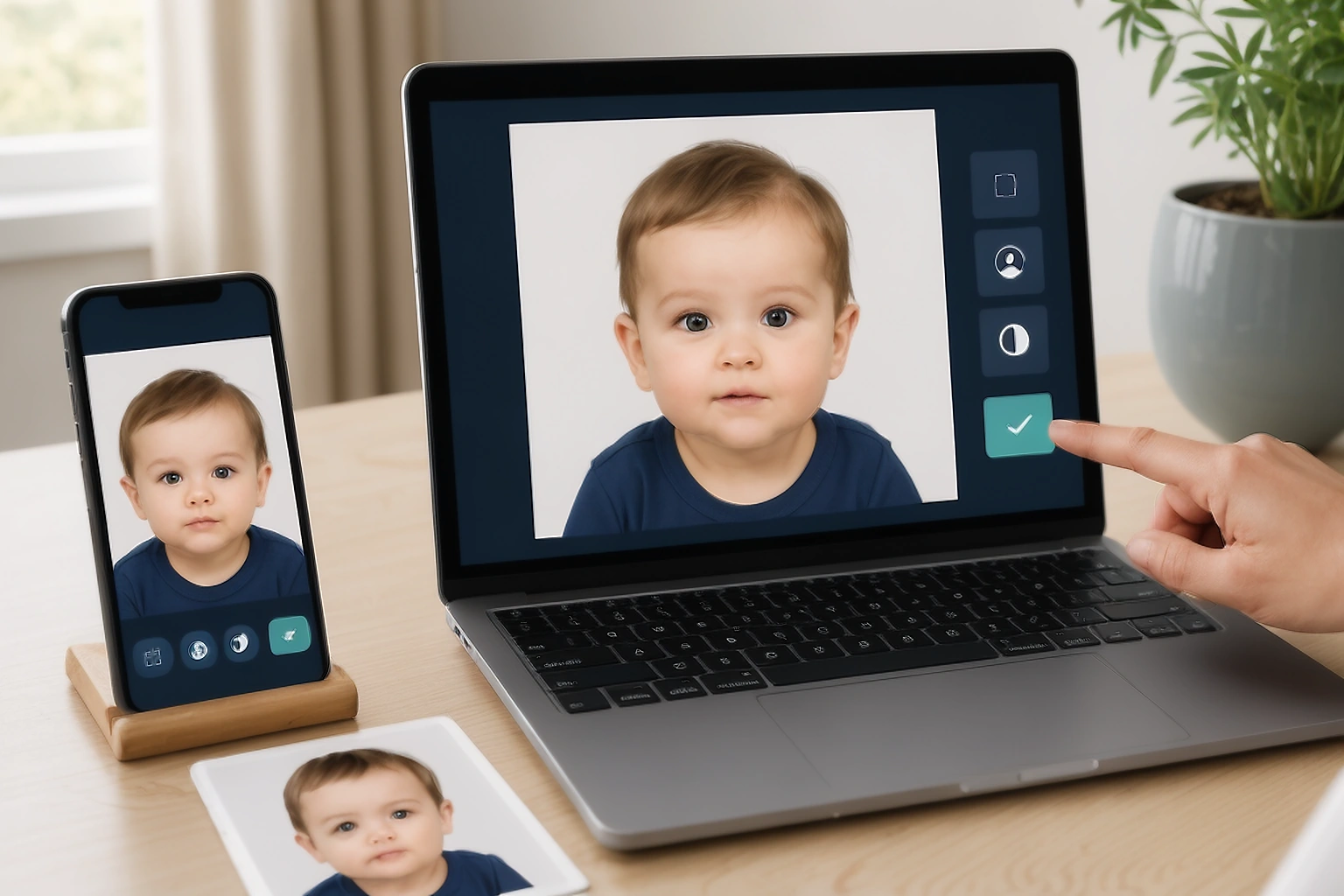
- The baby’s face is still sharp after export.
- No adult, hand, toy, dummy, or support has appeared near the edges.
- The background remains plain and free from strong shadows.
- The format, pixel dimensions, and file size match the current application instructions.
Do not upload a screenshot of the preview. A screenshot can change the dimensions and can add unwanted compression.
If the portal rejects the file, save the exact message before changing the image. That tells you whether the issue concerns the photo itself or the final file settings.
sometimes asked questions
How do I take a baby passport photo at home?
Place the baby safely on a plain light coloured sheet and photograph the child from above. Keep the baby alone in the frame and use even light without shadows. Check the exact authority rules before selecting the final image.
Can I take a newborn passport photo while the baby is lying down?
Some official instructions allow a newborn to lie on a plain sheet. The United Kingdom specifically says that children under one can lie on a plain light coloured sheet and be photographed from above. The baby must remain safe and no adult support should appear in the final image.
Can a parent hold the baby during the passport photo?
A parent sometimes needs to support the baby during the setup, but the parent’s hand or body should not appear in the submitted photo when the authority requires the child to be alone. For a newborn, it is safer to use a stable setup and keep the supporting adult outside the camera view.
Can a baby have closed eyes in a passport photo?
The answer depends on the authority and the child’s age. The United Kingdom does not require children under one to have open eyes, and the United States allows an infant’s eyes to be not entirely open. Other applications can require open and clearly visible eyes.
Can I use a car seat for a newborn passport photo?
Canada allows a newborn to be photographed in a car seat when a white blanket is placed behind the head and there are no shadows. This should not be treated as a universal rule for every country. Never place a blanket over the baby’s face or airway.
Can a baby hold a toy in a passport photo?
Do not leave a toy in the final image unless the exact authority clearly allows it. UK passport guidance says babies must not hold toys or use dummies. A toy can also distract from the face and make the image harder to review.
Can I edit the baby passport photo after taking it?
Use editing only for preparation that the exact application permits. Do not create open eyes, remove an adult’s hand, change the baby’s face, or replace missing facial detail. When the original photo has a serious problem, taking another photograph is safer.
What size should an Indian baby passport photo be?
Passport Seva instructions for minors below four refer to a recent colour photograph measuring 45 mm by 35 mm with a white background. The published minor guidance also refers to the face taking about 80 to 85 percent of the photo. Check the current Passport Seva page before printing because application instructions can change.
The short conclusion
Taking a baby passport photo is less about getting one perfect shot and more about creating a safe setup that gives you several clear choices. Keep the baby comfortable, use an even background, and make sure no adult support or object remains in the frame.
Age based exceptions can help, but they do not replace the official instructions for the exact application. Select the clearest original photo, prepare it according to the correct size and file rules, and inspect the saved image before submitting it.
Check the photo before you submit it
Open the PassportPhotoBox checker to review the visible image and the exported file details. Keep the official application page open because the receiving authority makes the final decision.
Official sources checked on 30 August 2026
The rules for babies and young children are different between authorities. These official pages support the age exceptions, home setup guidance, and size information used in this article.
- United States Department of State passport photo requirements
- Government of the United Kingdom printed passport photo requirements for babies and children
- Government of Canada passport photo requirements
- Passport Seva guidelines for capturing photographs for minors below four years
- Passport Seva current passport application process and minor photo instructions